Saturday, July 14, 2012

French Baba au Rhum, on July 14th or Bastille Day

A sleek, black and blue vehicle emerges from a platform like a Batmobile prancing across a screen, accompanied by music in a movie. Giant silver bullets with motors and doors lie peacefully, as metallic, prehistorically sized insects prowl nearby. The batmobile is one of 140 Bugatti automobiles from a 600-car collection in Mulhouse, Alsace--a National Automobile Museum. (Take a virtual tour by clicking on this link: http://www.youtube.com/watch?v=AtR5F9Cx0E4 It is in this French region Alsace Lorraine, where the baba au rhum dessert, now eaten all over France, originated. Some of Lorraine's attractions include the largest U.S. World War I cemetery outside of the United States, the birthplace of Joan d'Arc, and the Stanislas plaza in Nancy,where the polish king took over the duchy of Lorraine for a period of time.The first baba au rhum I tried was in a French airport. The miniature cylinder was brown in color, didn't have whipped cream, and was liberally soaked in a delectable rum sugar syrup. 

History     The babka, or polish yeast cake was taken to Alsace/Lorraine by the exiled Polish king Stanislas, who was appointed mayor of Nancy in Lorraine by his son-in-law, King Louis XV of France. Some report that he had trouble chewing on dried kugelhopf, and thus requested that alcohol be added to the cake to make it softer. Others say that he brought back a babka from home once; it dried up, and thus his chef added wine, raisins, and cream to soften the cake. The original shape of babas is a cylinder, but after 1835, when the modern rum baba was created, a ring mold called a savarin is also the common shape used. The baba was taken to Naples by French cooks, and is known by that name. The original baba has yeast; on easy french food.com you can find the following recipe that uses baking powder instead:

Recipe from 
3 eggs, separated
1/4 cup butter
1 cup flour
2 teaspoons baking powder
2/3 cup granulated sugar
1/4 cup milk
 Preheat oven to 350 degrees F. Beat the yolks and sugar for 2 minutes. Melt butter and add to the mixture. Next, stir in the milk, baking powder, and flour. Whip the egg whites, then fold them into the mixture. Pour into a greased flanera, savarin pan,or 6-cup ring mold. (You can also pour into several small pans for individual babas). Place in oven and bake for 25 minutes.
Rum Syrup
2/3 cup water
1 cup sugar
1/3 cup rum
Mix water and sugar in pan and heat until it boils. Remove from heat, cool and stir in rum. 
When the cake is still warm, poke holes in it with a toothpick or fork. Pour the rum syrup on the cake.
Decorate with 1 to 3 cups of whipped cream, to taste, and fruit.


http://www.youtube.com/watch?v=yEoHoffmbXI&feature=related
http://www.youtube.com/watch?v=ypdcF6yCXDE&feature=related
http://www.citedelautomobile.com/fr/home
http://about-france.com/regions/lorraine.htm


Saturday, July 7, 2012

Fourth of July Shortcakes (Sponge Cakes)


While shortcakes appeared in Europe in the 1500's, strawberry shortcake was created and eaten as early as 1847 in the United States. The original shortcake resembled a biscuit, and the strawberries were covered with icing. Gradually, it evolved to a sponge cake or angel food cake covered in whipped cream.


Sponge Cake Recipe http://www.bbc.co.uk/food/recipes/victoriasponge_13555
4 ounces butter
4 ounces sugar
2 eggs
1 teaspoon vanilla
4 ounces flour
1 tablespoon milk
Whipped Cream
blueberries
raspberries or strawberries

Preheat oven to 350 degrees F. Cream butter and sugar. Add eggs and vanilla, then beat for 3 minutes. Fold in flour, then add milk. Place in 3 greased and floured Wilton mini-fill pans. Bake for 19 minutes.

a. Place strawberries and whipped cream in the sponge cake to make a Strawberry Shortcake.

b. Place raspberries and blueberries and whipped cream on the sponge cake to make a flag design.


References


Monday, July 2, 2012

Natillas, to celebrate yesterday's Spanish Eurocup win!


As I walked on a straight path through small maze-like gardens, I wondered what mysteries I would discover behind the strong, 900-year-old stone wall. 


Natillas, a Spanish dessert similar to English custard


The halls, which surrounded a courtyard, were fit for pacing underneath gothic arches that adorned the ceiling like morning glories. This is the type of place where natillas, a custard-like Spanish dessert, came from. Nuns preferred natillas because they were inexpensive but at the same time wholesome and nutritious. 

This Spanish cloister is located in North Miami. A few decades ago, it was purchased by the Hearst family and it was shipped to Florida, where it was reassembled, piece by piece, like a numbered puzzle. 


If you burn sugar on top, you get catalan cream!

 Natillas were brought from Spain to Latin America, where they are enjoyed in countries such as Colombia (where the ingredients were tweaked a bit), Cuba, Mexico, among others. Cubans took this treat with them to Miami, where I tasted natillas for the first time at a Cuban restaurant in North Miami Beach. 


Natillas were taken by the Spaniards to Latin America
Recipe
2 cups milk
4 egg yolks
100 grams granulated sugar
1 tablespoon cornstarch
zest of half a lemon
cinnamon stick
raspberry sauce
blueberries and cranberries
vanilla wafers (optional)

Heat the milk, lime zest, and cinnamon stick. Whisk the yolks, sugar, and cornstarch together. When the milk boils, pour it through a sieve into the yolk mixture, then pour it back into the pot. Cook until it thickens and coats the back of a spoon. Place in a metal bowl and stir over cold/ice water until it's at room temperature. Place the custard in a dish and cover it with saran wrap and set in the fridge. Adorn it with blueberries, cranberries, a fruit coulis, and even vanilla wafers.
Raspberry Sauce (Coulis)
1 cup raspberries
4 tablespoons granulated sugar
Cook the raspberries and sugar, stirring, in a pot, on low-medium heat, until the mix thickens and turns into a sauce.

References
http://www.spanishmonastery.com/
http://www.justapinch.com/recipes/dessert/pudding/spanish-mango-natilla-natilla-de-mango-espanola.html
http://es.wikipedia.org/wiki/Natillas
http://www.justapinch.com/recipes/dessert/pudding/spanish-mango-natilla-natilla-de-mango-espanola.html
http://www.cubasolar.cu/biblioteca/energia/Energia41/HTML/Articulo09.htm
http://www.uefa.com/uefaeuro/index.html

Wednesday, June 27, 2012

Macarons in Poitou Charentes, France


La Rochelle
This seaside fort that is hundreds of years old has a massive cylindrical-shaped tower surrounded by a long wall, that gives a medieval ambience to shops that are not too far away. Together with the ile of Re, it was a stronghold that protected France, even during world war II, when the city was a submarine base.

In a bakery at La Rochelle, I recall finding a variety of flavored macarons. Not just food-colored macarons with varied jelly fillings, but different flavored macarons that came with flavored buttercream or ganache fillings. They had not only almond, chocolate, pistachio, and macarons; they also had bluegrass, jasmine, lavender, and rose. There is something scintillating about finding flavors that you don't expect in your dessert; not to mention finding flavors that you didn't even know were edible.
History of the Macaron
Near La Rochelle, in Montmorillon (Poitou-Charentes region), there is a museum dedicated to almonds and macarons, one of the towns where one of the earliest versions of macarons were first made since 1673, after the first non-sweet macaron shells (similar to amaretti cookies) were brought by the Medicis from Italy in 1611. The words macaron and macaroni mean "fine paste".
Almonds, the main raw material included in this delicacy, were first taken to Vienna from the Middle East.
La Duree in Paris, however, is the first place that made the modern version of the macaron, in the beginning of the 20th century. Pierre Desfontaines, a relative of the owner, placed ganache (melted chocolate with whipping cream) in between two macaron shells.
Other towns and regions reknowned for their macaron cookies, which are all differ quite a bit: Amiens, Le Dorat, Sault, Cormery, Joyeuse, Chartres, Nancy, Boulay, Saint-Emilion and Sainte-Croix.


My second Macaron Wreck, consisting of cracked shells.


Pierre Herme Recipe (adapted instructions and quantities) from Secrets Gourmands
140 grams of almond flour
240 grams powdered sugar
100 g egg whites, at room temperature
pinch of salt

Age egg whites for 3 to 5 days in the refrigerator, in a container that is loosely covered with aluminum foil. If you will make your own almond flour, loosely weigh the almonds, then blanche them (place the almonds in skins in boiling water for 2 minutes, then remove them) so that you can easily remove the skins. Once the skins have been peeled, let the almonds dry. Then you may place them in a coffee grinder, on the finest grinding setting. Grind the almonds, then sift the meal. Use only the almond flour that has gone through the sifter.
Sift the almond flour and powdered sugar, and place in a bowl. Beat the aged egg whites separately, then add them to the dry mixture. Beat at least fifty times.
Pour the beaten egg whites onto your almond flour mixture and gently fold them in, using a rubber spatula. Move your spatula from the bottom of the bowl to the edges with one hand, using your other hand to rotate the bowl. Watch a video to get a clear idea: http://www.youtube.com/watch?v=2L1zbAOQ3EI 
Now hit the spatula against the rim of the bowl until the batter falls in a wide ribbon when you raise the spatula. When you can´t see any crumbs of almond flour and the mixture is shiny and flowing, the batter is ready.
Place your batter in a pastry bag, and add a number 12 tip. Squeeze the bag in a 90 degree angle onto the parchment-lined baking sheet, that has the 2.5 inch macaron-patterned-printout underneath. If you prefer a smaller sized macaron, choose the 2 centimeter macaron pattern. It was surprising that one of the black and white patterns I found online was so pretty and elegant that it was perfect for putting me in the right mood for piping.
When you're squeezing, don't move it; just let the batter puff up around it, until the circle you see underneath the paper is full. Then shake the pan delicately sideways, against the tabletop, holding the paper in place with your thumbs,  until the tips on top of the batter rounds disappear. If necessary, poke them delicately with a spatula to get rid of them. Preheat the oven to 325 F. TIP: Let the macarons rest for 30 minutes.


TIP: Place the cookie sheet on top of another cookie sheet, and insert the pair in the oven. (TIP:) Insert a wooden spoon between the door and the rest of the stove. Bake for 14 minutes, and test; if it is necessary, leave it longer, until it is cooked. TIP: After you take them out of the oven, cool for 2 minutes before peeling them off.

Macaron shell wrecks


Filling

Chocolate Ganache
8 oz. semisweet chocolate
4 oz. whipping cream
Melt chocolate for 30 seconds in a bowl in the microwave, then stir. and add whipping cream.


TIP:Once you place the filling in between the shells, you can let the pastry wait for 1 or two days in the refrigerator until it has the right texture (some say it is a marriage of flavors).


Upcoming posts

Salted Caramels from France (Ile de Re)
Milk Candy from Antigua Guatemala


References:
http://issuu.com/helened/docs/demystifyingmacarons
http://www.squidoo.com/french-macaroon
http://foodnouveau.com/2011/12/16/france/a-macaron-troubleshooting-guide-useful-tips-and-advice-to-master-the-french-delicacy/
http://vivianmacaron.com/2011/06/preparing-to-make-macarons.html
http://lardonmyfrench.blogspot.com/2010/10/10-tips-and-tricks-for-making-french.html
http://www.laduree.fr/en/histoire/macaron
http://www.museedumacaron.com/press_book.htm
http://www.ville-larochelle.fr/en/decouvrir-la-ville/histoire-et-patrimoine.html

Sunday, June 24, 2012

Creme Papaia from Brazil

Waiters swiftly swirled platters around my table, placing slices of different cuts of meat on my plate. Their visits were constant and seemingly endless, and even educational--I had not been introduced, I thought, to so many different types of meat--and certainly not in that fashion. At times, they brought large chunks of meat on a skewer, and then sliced off very thin pieces with large, sharp knives. When I was full, I turned over a card that said "No more, thanks".
I was in a Brazilian steakhouse (churrascaria, barbecue) in Costa Rica; at the time, there wasn't one where I lived. It was a meat lovers' paradise. My favorite part of the dinner, however, would be the creamy dessert topped by the fruity cassis liqueur--it was unforgettable. The foamy mixture of papaya and ice cream was decorated and slightly flattened by the stream of purple, berry-flavored liqueur that was poured in front of me.


June 12th is Valentine's Day in Brazil. They call it Dia de los Namorados, or Lovers' Day, as it is the eve of St. Anthony's Day, the patron saint of marriage.

Lorena de Garcia's Recipe
1 pint of vanilla ice cream
1 1/2 cups skim milk
 1 oz. creme de cassis (currant liqueur)
1 1/2 cups ripe papaya, peeled and diced
Place all ingredients except for the creme de cassis in your blender. Once they are mixed, pour them into 4 serving glasses or dishes and pour a little bit of creme de cassis on top, in the center. 
Some people use yogurt instead of ice cream. I have not tried this variation yet--when I do, I will post my results here.

References
http://www.cheflorenagarcia.com/page/crme-de-papaya-topped-with-liquor-de-cassis

Tuesday, June 12, 2012

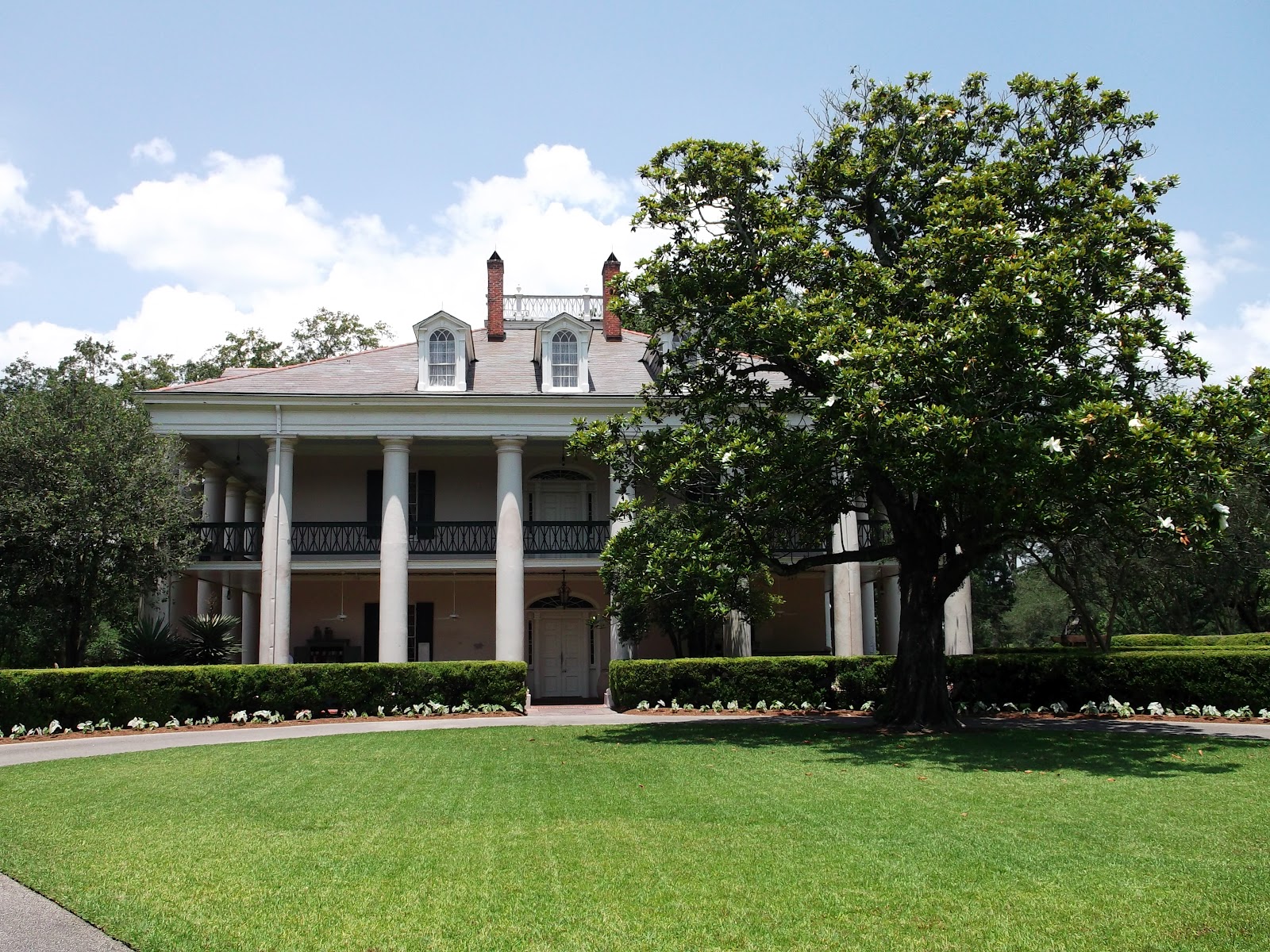
Buttermilk Pie at Oak Alley Plantation in Louisiana


A young woman in a flowering antebellum yellow dress gaped at the locked door to the patio. "That happens often. Some people say that a ghost is responsible," she commented, then told a man in our group how he could remove the lock. I shivered as I saw the black netting covering the mirrors in the lonely rooms, and observed an abandoned tea tray left on a bed. 
When we exited the house, I marvelled at the beauty of the oaks in the garden.  Two rows of them were facing each other, like the marines that held up swords out for contestants in the Miss Universe pageant. In this case, however, the star was not a person-- it was the plantation home. 

We were at Oak Alley Plantation, one of the old sugarcane plantations of the South, located in Vacherie, Louisiana. A leaflet outside the house boasted the movies (Such as Interview with a Vampire), TV shows (Ghost Hunters, for example), and Beyoncé music video that had showcased the lavishly set home. A ride on a road alongside the Mississippi River bank will take you past several sugarcane plantation homes that are about 45 minutes away from New Orleans.  Oak Alley (and several others, such as St. Joseph´s Plantation, Laura´s Creole Plantation) is located on the side of the river that is a bit more protected from the Mississippi River flooding.
Its restaurant features among many other dishes, several sumptuous desserts. The pecan pie I tasted was good enough to make me want to make it  and compare it to my present favorite recipe. For this post, I chose their buttermilk pie, something I had never tasted before (unless butterscotch pie counts).


Oak Alley Plantation Recipe

1 3/4 cup raw or light brown sugar
8 tablespoons butter
1/4 cup flour
1/2 cup buttermilk
1/2 teaspoon vanilla
3 eggs
9-inch unbaked pie crust
1/2 teaspoon cinnamon (sprinkle on top of pie after it is cooked)


Preheat the oven to 350º. After preparing an unbaked pie crust, mix the pie batter. Melt the butter in the microwave, place it in a bowl, and add sugar, eggs, flour, vanilla, and buttermilk (you can make the buttermilk by placing half a tablespoon of lemon juice in a 1/2 cup measure, then add milk until it fills the cup--let it sit for five minutes). As you can see in the photo on the left, the batter resembles pecan pie batter, except it doesn´t have pecans. After you have mixed the batter properly, pour it into the pie crust. Bake at 350 degrees for 50 minutes. When it is done, sprinkle the cinnamon on top. 
 References
Oak Alley Plantation Buttermilk Pie Recipe Postcard.
http://en.wikipedia.org/wiki/Buttermilk_pie
http://www.wisegeek.com/what-is-buttermilk-pie.htm
http://www.oakalleyplantation.com/visiting/restaurant/


Saturday, June 2, 2012

Cherry Clafoutis from Limousin, France

Cherry Clafoutis
I felt a strong tremor move the desk, floor, and walls around me. A few minutes later, the first thing I thought of doing was check the U.S. website that reported the magnitude of quakes around the world. Beneath the quake I had felt, on the chart, there was also a report of a small tremor in France, near the Massif Central. I didn´t know France had quakes and much less a volcano!
On a long train ride (about 30 hours) a few years later, travelling from southern to northern France, I realized the train would make a small stop at a  train station in the Massif Central. "How exciting!"  I thought, "I´ll be able to see France´s volcano! Earlier in the afternoon, the train cars travelled past the proverbial house built on a rock. Meandering rivers and green valleys surrounded a large cliff that held one house on the very top. Slowly, dusk was arriving. When we arrived at the long-awaited station, instead of witnessing a large volcano, all I could see was the pitch-dark dusk outside. I squinted, and still couldn´t see much.
Ceramic dishes made in Limoges, Limousin
About Clafoutis and Limousin
In Limousin, the bread basket of France, cherries are available from late May through June. Plums, peaches, apples, pears, figs, and medlar appear in the following months. Cherries are useful for lowering cholesterol, and for lessening inflammation.
Clafoutis comes from the verb clafir, which means to fill. The batter is filled with cherries. Others believe that the word clafoutis refers to the fact that the cherries resemble nails in midst of the custard. Those who dislike finding the pits in the cherries and therefore in the custard, will indeed feel that the cherries are as hard as nails.
The traditional way to make this dish involves leaving the pits in the cherries. In order to keep this recipe authentic, some cooks argue that the final product will be too liquid, because the cherry juices will leak into the custard, and they might have a point there. Others go so far as to say that the pits expel a special flavor to the dish. At any rate, if you want to make an authentic clafoutis, leave those cherry pits in. Look at the bright side. I know I did. You won´t have to pit the cherries! How easy can a cherry dessert get!


Recipe

1 pound of cherries, washed
3/4 cup flour
1/2 cup granulated sugar
3 eggs
1 cup milk plus 1/2 cup cream; OR  only 1 1/2 cups milk for a more authentic Limousin clafoutis
2 tablespoons melted butter
2 teaspoons vanilla
1/8 teaspoon salt


Grease the 9- inch round or square pan, and place washed, unstemmed cherries on it. I used sweet cherries, as many people do, though the authentic recipe calls for tart cherries. Place the flour and sugar in a bowl. Add the eggs, mixing them slowly into the flour. As it thickens, add the milk and melted butter, and make sure you don´t get any lumps. Add vanilla. Pour over cherries, and bake in a 375 degree F oven (190) for 45-60 minutes. It is cooked when you can press it lightly with your fingertips, and the top is golden brown.

References
http://suite101.fr/article/recettes-du-clafoutis-aux-cerises-traditionnel-et-autres-fruits-a13314
http://www.marthastewart.com/344662/cherry-clafouti?center=276955&gallery=274446&slide=282911
http://les-trois-chenes.hubpages.com/hub/Clafouti-with-Cherries-a-Traditional-French-Dessert-Recipe
http://www.easy-french-food.com/cherry-clafoutis-recipe.html
http://en.wikipedia.org/wiki/Clafoutis