Sunday, February 24, 2013

Chinese Fortune Cookies from San Francisco for their New Year


I held my breath as the car climbed a 40 degree street. When we precariously reached the top of it, I could see the city below, and could only anticipate what it would feel like to go down.
 Suddenly the vehicle was released much like a pinball, and it sped down the street like a roller coaster car. And the slow climb began once more, to take it once again. We searched for similar streets, and found and explored most of them.
The next vehicle we would take would be a boat--straight to an island that most people that visited it in the past dreaded going to--Alcatraz. If it hadn't been for the prison cells, the lovely view of San Francisco, the seagulls, and the boat ride would have made it feel like a pleasant seaside day trip, without the extra dose of excitement that prison cell stories gave it.


 Other pleasant visits in San Francisco are the Presidio and Golden Gate Parks, which have many beautiful views to explore, from Chinese or Japanese Gardens to ocean views of the Golden Gate.

History

One of the most credible stories about where fortune cookies were created claims that San Francisco was their birthplace.  They were gourmet treats called fortune tea cakes until a fortune cookie machine was created, and they were able to be mass produced.
Originally, Japanese Americans brought the idea to the United States of a similar confection in Japan. Chinese Americans later produced them, and it became a Chinese American tradition.

Recipe: http://www.marthastewart.com/262421/fortune-cookies
The instructions are quite clear, except I would add that it is better to make the cookies one at a time and/or on a griddle, as it is quite tricky to fold them! It is necessary to form them when they are very hot, before they are too brittle to be shaped.
The most fun part of making the cookies is typing up the fortunes--you get to choose your favorite ones, add lucky numbers, print and cut them out, and finally insert them in your concoctions!

References
http://www.nytimes.com/2008/01/16/dining/16fort.html?pagewanted=all&_r=0
http://www.fancyfortunecookies.com/Articles.asp?ID=148
http://en.wikipedia.org/wiki/Fortune_cookie

Saturday, February 9, 2013

Curdled Milk Candy from Ahuachapan, El Salvador

"La Asuncion" Church
The annual festivities in Ahuachapan take place on the second week of February, and are called the "Sweet Name of Jesus". Ahuachapan was originally founded in the 500's by the Pokomame Indians, but was not declared a city by the Spaniards until 1869.


Tower in Plaza Concordia

History

The curdled milk candy you can find in El Salvador is only made in the department of Ahuachapan; there it is known as "Dulce de Bodoque".  It was probably brought to El Salvador by the Spaniards in the colonial period, around the 1600's, as similar versions are also made in Guatemala, Peru, Cuba, Colombia, Venezuela, and the Dominican Republic.


Recipe (from Comida Tipica, by Vilma G. de Escobar)
6 eggs
1 liter of milk
1 1/2 cups granulated sugar
1/2 cylinder of solid brown cane sugar (panela), grated
2 tablespoons of lime juice
grated zest of 1 lime
3 cinnamon sticks
Panela, hard brown sugar
 Place all ingredients, except for the cinnamon sticks in a blender and mix well. Pour into a wide and tall pot, and bring to a boil. Do not move the liquid. Let it simmer for about an hour. By this time, you can move it a little bit if you need to avoid it sticking to the bottom of the pan.
 Usually it doesn't burn, but once in a while a few pieces might. When most of the liquid has disappeared, the candy will be ready, and its consistency will have become stickier and more solid.
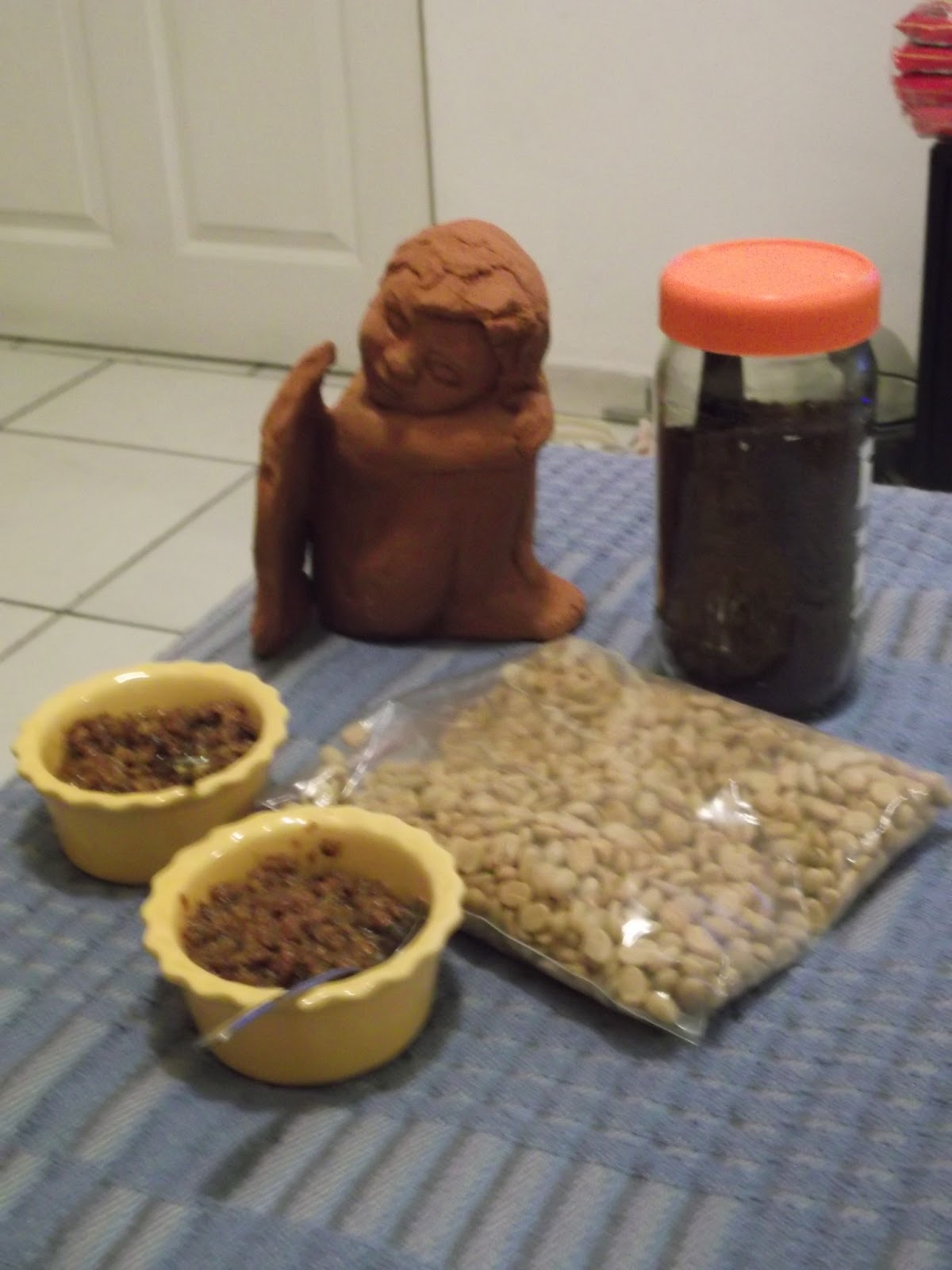
Dulce de Bodoque next to coffee beans and ground coffee


References
http://mekitchen.tumblr.com/post/36346284608/bodoque-de-morena-y-mi-abuela
http://mariscakes.blogspot.com/2010/07/dulce-de-leche-cortada-english-sweet.html

Saturday, February 2, 2013

Stroopwaffels in Amsterdam for Candlemas


Someone moved the bookshelf, which opened like a door, revealing more rooms inside. I stepped in a genuine secret chamber for the first time--before, I had only read about them or played pretend. Here, the austere quarters of a young girl and her family took me to the 1940's, when Amsterdam was occupied by Nazis. I was in Anne Frank's house.
That was not the only time travelling I did in this city. I was able to mix colorful powdered earth for paints in Rembrandt's home from the 1600's, and to witness more than one of Van Gogh's 19th century sunflower paintings in his museum.
Outside the royal palace, amid festive carrousels and other rides, at Dam Square, I enjoyed patats (french fries) with mayonnaise, and slices of gouda at a bakery. Cheese is not the only invention the town of Gouda left us. Stroopwaffels were also made there for the first time.
Stroopwaffels
These cookies were invented in Gouda in 1784. Its creator, Gerard Kamphuisen, put crumbs and spices together into a waffle, and them spread it with syrup. It became known as the poor man's cookie, because it was made out of leftovers.


Recipe
-Cooked pizelles;find recipe at http://recipecircus.com/recipes/Stella/ETHNIC/Dutch_Stroopwafel.html


My Molasses Filling Recipe
1 cup brown sugar
8 tablespoons of butter
3 tablespoons molasses
1 tablespoon corn syrup
1 tablespoon cinnamon

Cook brown sugar, 6 tablespoons of butter, molasses, corn syrup, and cinnamon until the mixture reaches 240 degrees. Remove from heat, then add 2 tablespoons of butter.

Take a pizelle and spread 2 tablespoons of molasses filling on top of it, then stick another pizelle onto the filling. Use a heart-shaped cookie cutter, preferably a comfort grip cutter. Cut through the sandwich cookie and remove excess.
If you place the cookie on top of a cup of coffee, the vapor should warm it.

Friday, February 1, 2013

Mauritian Banana Tart for February 1st


When I was in tenth grade, I had to complete a social studies project on an island I had never heard of before--Mauritius. Light green palm trees leaves graced the pamphlet I would later receive by mail. Because there was no internet at the time, that would be all the extra information I would get, other than short accounts in encyclopedias at the library.
Now, however, thanks to the internet, anyone can find travel packages and tourist attractions galore. (See
http://mauritiusattractions.com/mauritius-attractions-c-24.html )  Mauritius is more than a few palm trees; this is proven by the fact that it won a Travelers' Choice Award for 2012. It has tea plantations, French chateaus, colonial houses, safaris to see zebras/lions/cheetahs/tigers, giant tortoises, rum breweries, salt basins, and a sugar museum.
The following video shows waterlilies that are larger than baseball bases, pencil thin waterfalls on steep cliffs, as well as mountains that look like Mexican hats or brown goblins: http://www.youtube.com/watch?v=O0KFH15Tn-U
But now let's get to the recipe section. I found and made a wholesome tart that is mostly freshly cooked fruit.

Festivities in Mauritius
Mauritians hold the spiritual Cavadee Festival at the end of January and the beginning of February. The indians of Tamil origin place needles in their body and carry an ark on their back.
On February 1st, the abolition of slavery that took place in 1835 is conmemorated every year. The Dutch first took people from Madagascar and the East Indies to develop the island, during the 17th and 18th century.

Recipe from http://inspiredtobake.wordpress.com/2010/03/04/tarte-a-la-banane-recette-mauricienne/
Crust
2 cups flour
175 g butter
Filling
2 cups banana puree
4 tablespoons granulated sugar
1 teaspoon vanilla extract


To make the crust, mix all the ingredients for it together and roll into a ball. Roll out the dough and cut into one-inch strips.

I painstakingly placed the strips on one by one. However, now I purchased a nordicware mini pie pan that allows you to cut the lattice all at once!


Reference
http://inspiredtobake.wordpress.com/2010/03/04/tarte-a-la-banane-recette-mauricienne/
Video: http://www.sbs.com.au/food/recipe/150/Banana-tart/
http://globaltableadventure.com/category/recipes-by-category/favorites/mr-pickys-favorite-recipes/

 http://www.youtube.com/watch?v=krHmNb-evdc

Saturday, January 26, 2013

Mango Smoothie from India for Republic Day (Mango Lassi)


Who knew there were smoothies as early as 1000 B.C.? They originated in the Punjab region of northern India (and Pakistan), where yoga was born.  It is perfect for hot weather (you didn't need me to tell you that), and is usually taken with lunch.The salty version includes cumin and yogurt, whereas the sweet version, sugar, fruit and maybe cardamom. Add turmeric, and you get a remedy for gastroenteritis, as well.


Republic Day, January 26th

In 1950, India's new constitution became official, thus turning the state into a republic. This day is celebrated with parades in the national and state capitals. In addition to the military displays, the different customs, dress and music of the diverse states in India are represented as well (you can find photos at http://www.firstpost.com/india/images-pomp-and-grandeur-at-indias-64th-republic-day-parade-602959.html).


Recipe
1 cup pureed mango
1/2 cup yogurt
1/2 cup milk
1/8 teaspoon ground cardamom
1 tablespoon honey
1 cup ice

Blend the mango, yogurt, milk, honey, and cardamom. Blend in the ice as well. Serve.

References
http://www.dahlicious.com/Lassi.htm
http://en.wikipedia.org/wiki/Lassi
http://www.timesnow.tv/videoshow/4419716.cms
http://en-maktoob.screen.yahoo.com/republic-day-colourful-tableaux-display-075800448.html

Wednesday, January 23, 2013

Chinese Dim Sum Mango Mousse for Tea


The closest I've been to China is Chinatown, but I do often have a surplus of mangoes often.  And ever since I was introduced to a tea tasting tradition during my singing lessons, I keep many tea varieties at home--ginger, jasmine green, lavender, rooibos, chamomile, and others to honor my Irish roots (the Irish drink the most tea per capita in the world)... It thus seemed appropriate to place both together in a Chinese tea-tasting meal called "Dim Sum". 

Dim Sum stands for "touch the heart", and it means bite-sized portions of food that are served with Chinese tea. The tradition originated when people travelling back and forth from China to buy silk (a Chinese trade secret at the time) needed to rest during their journey. Teahouses appeared on the route to offer tea tasting (the very appropriately named "yum cha") opportunities for farmers as well. When the Chinese discovered that tea would help rather than hinder digestion, they began including small portions of food on the platters as well. In the Southern region, the Cantonese turned the tradition into a boisterous but fun experience, and Hong Kong chefs have declared it brunch, as they serve it from 6:30 a.m. to mid-afternoon. Nowadays, you can find frozen dim sum in the supermarket, or street dim sum on a skewer. 

As for the beverage part of this custom, it was discovered accidentally in 2737 B.C., when an emperor smelled the aroma created after a tea leaf blew into a pot of boiling water. Whereas the Chinese don't have as elaborate a ceremony as the Japanese do, they view it as a symbol of respect and follow some etiquette rules. When tea is served, it is customary to thank the waiter by gently tapping the cup with the index finger. If you want him/her to refill your pot with more boiling water, you can do so by lifting the lid and leaving it open.


Recipe from http://www.anyrecipe.net/asian/recipes/mango.html (the book "Dim Sum" by Ellen Leong)
3/4 cup boiling water
1/2 cup water
2 tablespoons gelatin
1 1/4 cup sugar
2 cups pureed mango
1 ripe mango, peeled and sliced
1 cup whipping cream

Pour gelatin over 1/2 cup water. Add boiling water, then sugar. Mix in mango puree, then whipping cream. Place in ramekins or bowls and let set in the fridge. Decorate with mango slices. Cover the tops with saran wrap if you plan to leave them in the refrigerator for more than a day.

Coming up next:
Indian Mango Lassi for Republic Day, January 26th
Mauritian Banana Tart for February 1st
Chinese Fortune Cookies for the Chinese New Year in San Francisco, February 13th

References:
http://www.amazon.com/gp/product/0609608878?ie=UTF8&tag=anyrecipe2-20&linkCode=as2&camp=1789&creative=9325&creativeASIN=0609608878
http://en.wikipedia.org/wiki/Dim_sum
http://www.chinahistoryforum.com/index.php?/topic/2991-dim-sum-a-little-bit-of-heart-beginners-guide/
http://www.crazyfortea.com/strangeteafacts.html
http://www.twoleavestea.com/n_Chinese-Tea-Traditions-50.html

Thursday, January 17, 2013

Papaya Pie from the Virgin Islands

A slice of papaya pie

I was a bit frightened--we were lost on a hilly dirt road in our little Chevy Aveo and I could see the precipitous drop to the side of a cliff beside my window. "Please, let's go back," I begged...
We returned to the main road, which was somewhat flat, and stopped at the first business we spotted.

"Welcome to the island" was the greeting we received from the head bartender at the Jolly Roger bar. He enjoyed a good laugh at our expense, after hearing about our misadventures upon arriving at the island. Quickly, he summoned one of the waitresses, who was going home, asking her to lead us to our hotel.

The following day, we would experience winding roads in daylight, a much more pleasant venture. The view of numerous islands out in the shining deep blue ocean improves the higher you climb. We also visited a centuries-old sugar mill, a sugarcane brewery, and pristine beaches in different locations.


Tufts of lavender shaped like pigs, whales, and other animals lie clumped on the blue porcelain bay. 

Lunar landscape within a papaya fruit


Recipe (adapted from http://www.grouprecipes.com/68108/caribbean-papaya-pie.html )
3 medium papayas (6 cups or 3 pounds)
1/2 teaspoon lime zest
2 teaspoons lime juice
1/8 teaspoon of cinnamon
1/2 teaspoon orange extract or vanilla or 1 tablespoon Grand Marnier
4 tablespoons flour
4 tablespoons sugar
4 egg whites
1 baked pie crust


Remove peel and seeds from papaya. Chop into one inch cubes. Add lime zest, lime juice, and cinnamon. Next, add flour and sugar.  
Whip egg whites and fold them in. Place filling in baked pie crust. Bake at 350 degrees for 45 minutes.


 Let cool. Refrigerate before serving.

References
http://www.grouprecipes.com/68108/caribbean-papaya-pie.html