Sunday, August 12, 2012

Mango Sticky Rice for Thailand's Mother's Day


Kids climb trees, in spite of the fact that it scares their mothers, who are afraid they might fall off it and break a limb, or get electrocuted. In many Latin American and Asian countries, and some African countries, mango trees can reach very tall heights, and are still the most popular ones among children, because the golden prize for disappearing behind the finger-like leaves lies among the branches: the mangoes themselves. Most of them emerge unscathed, fortunately, thus being more motivated to continue engaging in what could be called an after-school sport for some. For others, it is even necessary for survival, when food is scarce for economic reasons, and in remote places where school buildings are nonexistent, classes might take place under the mango tree. In the Dharhar town in India, planting mango trees that will later become a girl's dowry even saves newborn girls' lives.

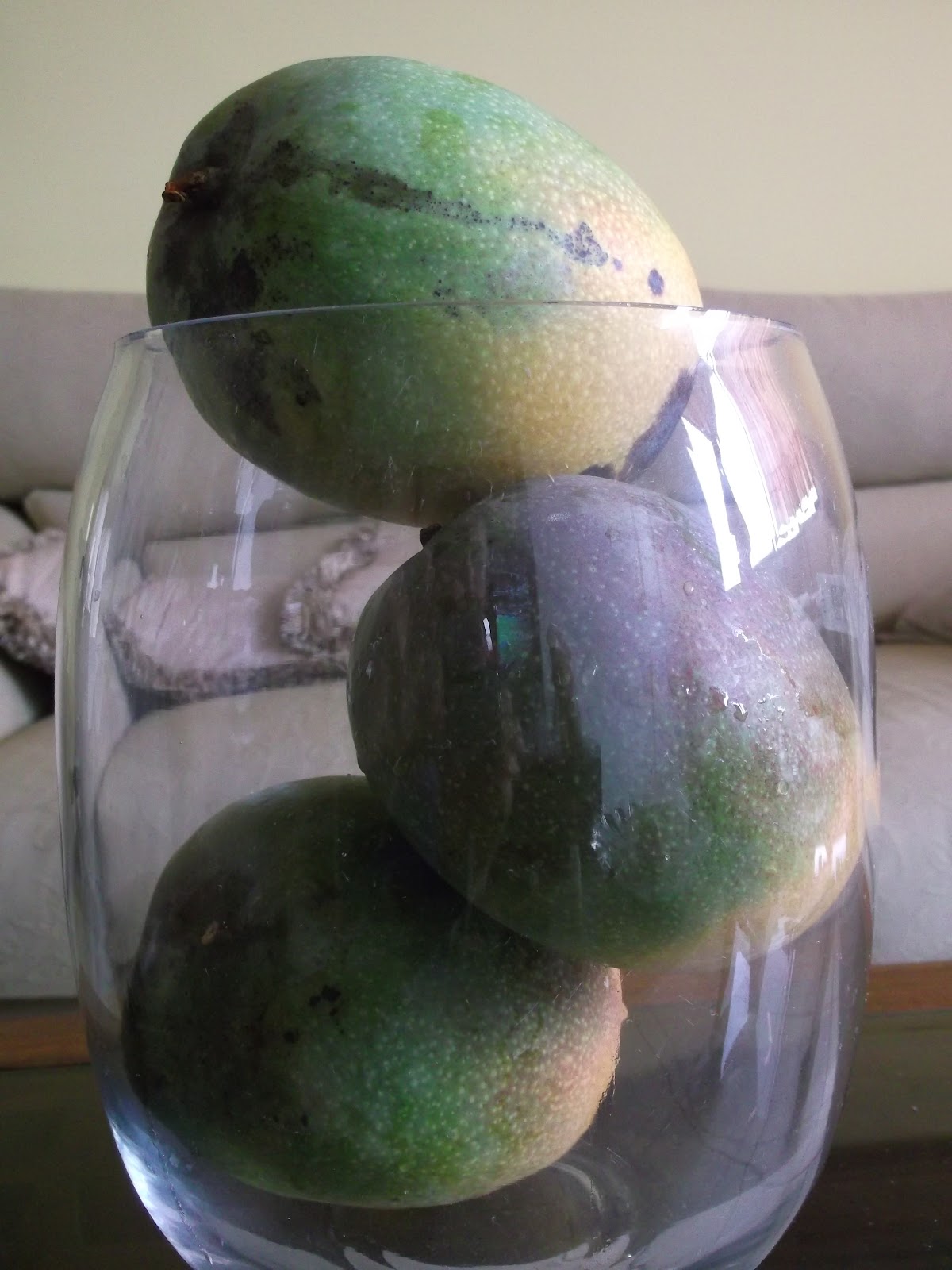
I don't recall ever climbing a mango tree, but I was recently armed with a sack full of mangoes, as they are in season from April through July...and thus set out to find world desserts that use this luscious orangey, buttery, melt-in-your mouth fruit that contains most of the Vitamin C you need in the day.


The Queen's Birthday
In Thailand, the current regent queen Sikrit's birthday is celebrated today, August the 12th. It is automatically also considered Mother's Day in the country, and is a moveable national public holiday, so the day off is tomorrow, August 13th. Bangkok holds many festivals and events on this day, but the more traditional provinces in Thailand also revere this day. The exteriors of buildings are decorated with the national flags, lights, and more. People offer flowers and gifts to their mothers and other women they honor, and do charity this day, including giving food to monks.


Recipe for kao niow mamuang: 


References
http://bangkok101.com/2012/08/hm-queens-birthday-august-12/
http://www.hoteltravel.com/thailand/guides/festivals.htm
http://www.squidoo.com/best-time-to-join-a-celebration-in-thailand
video: http://sumeiyu-thailiving.blogspot.com/2009/03/making-sticky-rice-and-mango.html
http://thaifood.about.com/od/thaidesserts/r/mangoricepuddin.htm
http://www.asiarooms.com/en/travel-guide/thailand/thailand-festivals-and-events/hm-the-queen-s-birthday-celebration.html
http://www.bioline.org.br/request?js06032
http://www.ecoavantdigital.com/politica-y-economia/143-las-ninas-de-los-mangos-


Wednesday, August 8, 2012

Eton Mess from London


Miniature replica of the queen mother's carriage, from the 1952 coronation of Queen Elizabeth II
Miniature of queen mother's carriage, Eton Mess, and a Wedgewood vase
You find yourself in a medieval building with a wooden interior, amongst many different types of suits of armor. The drafty room chills you as you climb the stone stairs. Many people were imprisoned in these quarters centuries before. You go through one of the many towers in the Tower of London complex quickly, before visiting the queen's jewels in the next building...
There, you stand on a treadmill to fleetingly view the jewels for a few seconds, before you return to take it one more time to catch another glimpse of some of the largest material treasures in the world.


The original Eton Mess contains whipped cream, strawberries, and broken pieces of meringues. It began as a mix of bananas or strawberries with ice cream or cream that was served at the Eton School in London, and has been traditionally eaten on June 4th. For this year's Diamond Jubilee, however, several new versions were created, and the simple dessert became more complicated but certainly more delicious than ever. 


Tower Bridge


Heston's Recipe (adapted)

Crumble
50 grams sugar
65 grams ground almonds
50 grams flour
pinch of salt
50 grams butter


Strawberry and Rose Coulis
200 grams quartered strawberries
200 grams whole strawberries
120 grams sugar
1 tablespoon amaretto
1 teaspoon rosewater or to taste
juice of 1 lemon

Marbled Cream
160 ml whipping cream
400 grams yogurt
60 grams broken meringue pieces


Preheat oven to 325 degrees. Mix the ingredients for the crumble and place them on a baking sheet in the oven for 30 minutes. Place sugar on strawberries in the blender and let it sit for 15 minutes. Then add the rest of the ingredients and puree.  Finally, mix some whipping cream with yogurt. Take a parfait glass, and add a layer of cream, then some puree, another layer of cream, crumble some meringue pieces and add more puree. Finally top it with the almond crumble.


Coming up next:
Thai Sticky Rice with Mango
British Bakewell Tart
Indonesian Banana Rice Tamales
Philippine Mango Float
Moroccan Almond Paste Horns


References
http://www.dailymail.co.uk/home/you/article-2149805/Recipe-Heston-s-Diamond-Jubilee-strawberry-crumble-crunch.html
http://en.wikipedia.org/wiki/Eton_mess

Monday, August 6, 2012

Sweet Potato Candy from San Vicente, El Salvador

The San Vicente Tower, built in 1930, in the capital of San Vicente is climbed every day by tourists

A large weaving wheel spun in front of me, as the soda-can spools were slowly being filled with thread, by a productive spinner lady who might have been a character in a German folktale. Might it turn into gold the following morning? Had I been transported into the past, before the Industrial Revolution? Maybe it had magical powers, like it did in Sleeping Beauty or Norse mythology.
    In the next room, a weaving machine hypnotically moved from left to right and back, then upwards and downwards. Gradually, a long piece of material decorated with colorful patterns appeared. It would soon be a tablecloth. I didn't wait to eat lunch on it, as it would take quite a bit longer for it to be finished...
     Instead, I journeyed to a nearby town, and stepped into a sugarcane field. Green blades of grass protruded from fingerlike sticks, much like feathers sprout from a bird's crest or tail. Many of the stalks had already been cut and thrust into a mill. In large vats, the resulting syrup was heated and classified into different qualities of syrup. Raw sugar was produced, as well as a thick, dark brown version that would be placed in wooden molds. Small barrel-shaped, solid blocks of candy emerged and were wrapped in corn husks by women, to be sold as "panela", that could be melted with different fruits to make other types of candy.
     After my visit to San Sebastian in San Vicente (where weavers worked with the same machines or similar machines to those they used 100 years ago or more), and to a sugarcane mill in Verapaz, San Vicente, I was ready to make some sweet potato candies.... So I warmed up by climbing the five-story white tower in San Vicente, the department's capital.

August 6th
A national holiday in El Salvador takes place on August 6th each year. In San Vicente, they always have sweet potato candy available for any fair or special event. In fact, the candy shops sell it year-round, too.


Sweet potato candy on a woven tablecloth from San Sebastian
Recipe
1 1/4 pounds of boiled, then mashed sweet potatoes
1/2 pound of granulated sugar
2 cinnamon sticks
1 cup of milk

Place all ingredients in a large pot and cook until the mixture thickens and sticks together into a ball. Let it cool for ten minutes. Next, shape it into small cones with your hands. Stick them into syrup (see recipe below) to coat them. Yields: 30 medium-sized cones.

Syrup
3/4 cup of granulated sugar
1/2 teaspoon of lime juice
2 strips of lime peel
1 cinnamon stick
3 tablespoons of water
Place all ingredients in a 2-quart pot and heat until it reaches the soft ball stage. You can test it by placing a drop in a glass of water. If the drop turns into a soft ball, it is ready.
Traditional weaving machine used to make tablecloths and hammocks, located in San Sebastian, San Vicente

Large spools filled by hand to place in the weaving machine

A more "modern" version of the weaving machine

References
http://www.thorshof.org/spinmyth.htm
http://www.cocina33.com/receta/dulce-de-camote-de-san-vicente
http://es.wikipedia.org/wiki/Panela
http://www.laprensagrafica.com/economia/nacional/93314-trabajos-de-trapiche-y-molienda.html

Saturday, August 4, 2012

Milk Pastries for San Salvador Festivities (August 3-6))


Dancers wearing colorful,  traditional costumes


The volcanic crater of Quezaltepeque


The sleepy crater resembled a giant, natural stadium, and we were the only fans in sight that day. "Look at the small store and the path into the crater", someone pointed at numerous trees that resembled moss or shrubs from far away, and even though I squinted, I failed to see anything. I could only tell that it must be a long trek downwards, into what could have been the center of the earth, as far as I was concerned. The zipline I had taken earlier that flew over these trees was much easier in comparison.
As we left, the path was sprinkled with small pieces of porous lava rocks, orchids, and red hibiscus flowers, and there were ladies selling warm corn beverages, flowers, or recently picked miniature wild raspberries. We had just visited the Volcano of San Salvador, or Quezaltepeque, near the capital city of El Salvador.
The previous statue, which was very similar, fell down during an earthquake in 1986, and a new one was built and set up in its place.

August Festivities
In San Salvador, the city's patron saint is Jesus, or the "Divine Saviour of the World" ("El Salvador del Mundo") The festivities last for four days, beginning on August the third, during which a national fair, rides, parades, and other activities take place. The entire country also has a day off on August the 6th, for the same occasion. 

Milk Pastries
Throughout most of El Salvador, soft round pastries are filled with a milk pastry cream, or apple or pineapple jelly. They are eaten year-round, and may be served for breakfast or dessert.

Recipe
Pastry
1 pound of sifted flour
3 tablespoons of sugar
1/2 pound of butter
1 teaspoon of salt
1/4 cup warm water
3 egg yolks
4 teaspoons of baking powder
Mix the butter, salt, and egg yolks. Add the flour and baking powder. Then add the warm water slowly, until the dough is easy to handle. Roll it out and cut out 2-inch circles. Barely wet the edges of two circles, then place a teaspoonful of the white cream filling between both of them. Pinch the edges of the circles together until the pastry is completely sealed shut. Brush milk on the tops of the pastries and sprinkle granulated sugar on top. Place in a preheated 350 degree oven and bake for 15 minutes. 

White Cream Filling (Leche Poleada)
2 1/2 cups milk
1 piece of lime peel
1/4 teaspoon of salt
3 tablespoons of cornstarch
1/2 cup of sugar
cinnamon stick
1 teaspoon of vanilla

Stir two cups of milk with the lime peel, salt, and cinnamon stick; place it in a pot and heat it until it boils. Dissolve the cornstarch in 1/2 cup of milk, then add sugar and the warm milk liquid to it. Place it back in a pot, and stir on medium heat until it thickens. Remove it from heat; add vanilla.

The entire plaza was redesigned in 2011.


Wednesday, July 25, 2012

Spanish St. James Day Almond Tart, July 25th, (Tarta de Santiago)


I duck swiftly as a very large silver object comes flying in my direction--it fortunately missed my head by a few inches! Its pendulum swing sends it violently back and forth like a metallic pinata; it is propelled by a rope pulled by several men huddled in a circle. A minute later, when it has lost momentum, a man tugs it by spinning around it like a ring game. It finally stops, and a crowd of people claps. They have been watching an 60-kg incense burner being moved by seven priests in a medieval cathedral, in the town of Santiago de Compostela.

Along with Jerusalem and Rome, Santiago de Compostela was one of the three major pilgrimage destinations during the Middle Ages in Europe. Pilgrims believe that it is the burial site of the apostle St. James, who came to Spain to convert the population to Christianity. Spaniards believe that Santiago, their patron saint, protects their country in times of need. Today, pilgrims from Spain and far away countries visit Galicia to walk on the Santiago de Compostela road, or the way of St. James, for weeks. There are several routes. The most difficult but reknowned one, the "French route", begins in St. Jean-Pied-du-Port, in the French side of the Pyrenees mountains, a few miles from the Spanish border. The other three start in Spain, Portugal, and England.  Most of the walkers are Catholic, but some of them are not; they nonetheless look forward to a spiritual experience. Their destination will be the Santiago de Compostela cathedral. They wearily stop at small hostals at night to rest and recuperate, as the following day they will be busy, walking again.
Galicia is located to the north of Portugal, and is surrounded by the Atlantic Ocean and the Cantabrian Ocean. To the east, it borders the Spanish regions of Asturias, Leon and Zamora.

Santiago Tart, or St. James Tart
The Santiago tart, or St. James Tart, is a dessert from the Spanish region of Galicia, and can be found in bakeries in July and the beginning of August, because St. James Day is on July 25th. This dessert was made at least as early as 1577. The first written recipe was recorded in 1838, and the St. James' cross figure decoration on the cake was started in 1924. Six years ago, this regional dessert was officially protected by the government, much like wine and cheese are; it has its own denomination of origin.
This luscious almond tart can be eaten with milk or a sweet wine. It is one of many Spanish desserts that use just the right amount of lime zest to flavor the batter.

Recipe
1/2 kilogram of ground almonds
1/2 kilogram of sugar
7 eggs
100 grams butter
150 grams flour
1 teaspoon of cinnamon
1 cup of sweet sherry
50 grams powdered sugar
Mix one egg, butter, flour, and water to make the dough that you will spread out thinly in a round pan. Stir the ground almonds, sugar, cinnamon, sherry, and eggs. Spread over the dough and place in the oven at 325 degrees for an hour, until it is cooked. Take it out of the oven, cool, then sift powdered sugar on top of it. Place a template of the St. James Cross or the emblematic seashell on top of the cake, in the center, before sprinkling the sugar on top; this way, the design will appear when you remove the template. The following link has a template: http://lacocinadesabela.blogspot.com/2011/05/tarta-de-santiago-con-plantilla-para.html


References
http://www.turgalicia.es/recomendacions/visitasvirtuaiscatedrais.asp?cidi=G&ctre=visitasvirtuaiscatedrais 360 degree view of cathedrals
http://www.turgalicia.es/fotos/IMAGENES/FLASH/ARQUITECTURARELIGIOSA/vtour_santiago/index.html
http://foro.enfemenino.com/forum/cuisine1/__f16046_cuisine1-Tarta-de-santiago.html
http://www.paulinacocina.com/tag/tarta/

Monday, July 23, 2012

White Milk Candy Sticks (Canillitas) from Antigua Guatemala, July 25, Fiesta Santiago


Massive stone walls that are semi destroyed, and run over with vines and grass, welcome visitors in Antigua. Spacious buildings with Spanish colonial architecture, boast harmonious arches. Tall churches and peaceful cloisters that used to be inhabited by Catholic nuns are sprinkled throughout the venerated city. Many of these nuns must have brought or concocted the recipes for candy that is still sold today.

"What would you like me to bring back from Antigua Guatemala? "Canillitas (Milk Candy).." is always the reply I get or make. The white version of these candies are probably one of the most popular souvenirs, and are quite different from the brown-colored dulce de leche that is available around much of Latin America. One of the most famous candy stores that sells these sugary candies that melt in your mouth is called Dona Maria Gordillo, and most of the stores are family-owned, and use recipes that have been passed down from one generation to the next.


Santiago Festivities in Antigua Guatemala, Guatemala
Canillitas are sold for special occasions, such as religious festivities (such as Easter) or in fairs, or in certain towns such as Antigua Guatemala or Sololá. One of Antigua Guatemala's festivities is on July 25th, when it celebrates the Fiesta de Santiago, its patron saint. The old city of Guatemala, protected by UNESCO since 1979, was named Santiago de los Caballeros de Guatemala, (Santiago of the Knights of Guatemala) not Antigua Guatemala, its current nickname. It was founded in 1524, but had to be rebuilt for a third time in 1566, after two catastrophes. It was the capital of Central America, but its glory ended when two strong earthquakes destroyed it on July 29, 1773. Hence its current name, Old Guatemala. The capital city was thus rebuilt in its current location, which lies 40 km away. 


ABOUT MAKING THE CANDY

The dough is molded into different shapes. The candymakers in Guatemala use ceramic molds to make small roses and angels and leaves, as you can see from the picture above. I used Guatemalan ceramic molds to make most, and made the larger rose by hand. This method for making the candy is clearly not the original recipe used more than a hundred years ago. Nonetheless, it gives similar results.

Coming up Next
Santiago Tart, from the Spanish region of Galicia
Thai Mango Sticky Rice
Philippine Mango Float
Salvadorean Pastelillos de Leche


References

Monday, July 16, 2012

Italian/Sicilian Cannoli on the Freedom Trail, in Boston


I quickly stepped inside the brown-gray wooden home with diamond-shaped glass windows built in 1680, to stand in front of the small hearth and warm my hands after having walked for long out in the cold. I found fruit and bread on the table, which helped me feel welcome in the austere and humble abode. Paul Revere wasn't there, so he might have been showing people his engraving of the Boston Massacre, or maybe he left on an emergency horseride to send a message to John Hancock and Samuel Adams.
I was in the Paul Revere historical home in Boston. However, it is 2012, even if for a moment I almost believed I had travelled in time to 1775.
You might not associate cannolis with the Fourth of July, but in Boston there is definitely a geographical connection.Many advise to begin the freedom trail walk in this city, in Little Italy, or the North End, where the most popular dessert is the Sicilian cannolo or cannoli. This delectable dessert is satisfying thanks to its wholesome ricotta filling. Right next to this part of town, you will find Paul Revere's home (where he lived for more than 30 years), reminiscent of Shakespearean buildings. The community was predominantly Jewish and later Irish only a few years before the Italians became the largest group in the neighborhood in the 1900's; today they still constitute 40% of the population. 


History of the Cannoli
Cannoli comes from the word canna, which means reed, after the tubular shape. It originated in Palermo, Sicily, and was often eaten during Mardi Gras season, before Lent. Whereas some people believe that the pastry appeared during the Arab rule in Sicily (827-1091) and was thus an Arab confection, others declare that the dessert was created by nuns, in a convent in Palermo. Still others believe that it was an Arab confection served in harems, and taken to convents when some Muslim women converted to Catholicism. Many years later, when Italians who lived abroad weren't able to get ricotta easily, they sometimes placed a custard filling in cannoli instead.
Cannoli are eaten widely during the Italian summer feasts that take place in Boston. The largest Italian feast in New England, St. Anthony's Feast, takes place from August 23-25.
This pastry is golden in more ways than one--some people might even accept it as currency! On a wintry and windy night in March, I had a cannoli in a labelled box with me when I asked a Boston street vendor how much a hat would cost. "$5, but I would be willing to trade it for your cannoli!" the vendor grinned, eyeing the pastry.


Recipe (Italy the Beautiful Cookbook, Lorenza de Medici)
10 oz. ricotta
1 cup sugar
3 oz. chopped mixed candied fruit
2 1/2 cups flour
1/4 cup white wine
2 tablespoons honey
pinch of salt 
1 egg
1 egg white
oil
confectioner's sugar
Mix the ricotta, 1/2 cup of sugar, the candied peel, and place in the refrigerator.


Pour the wine into the flour in a bowl. Add honey, 1/2 cup sugar, salt, egg, and egg white. Knead and shape into a ball, and refrigerate. Roll dough out and cut into 4-inch squares. Wrap around the metal cannoli cylinders and seal them closed.


Fry the dough in the tubes until golden brown.

Remove from oil and slide the cannolis off the tubes. Place the ricotta filling in a pastry bag, and squeeze into the cannoli shells. Sprinkle the filled shells with powdered sugar and serve!
References
Italy the Beautiful Cookbook, Medici, Lorenza de; 1996. Sydney: Harper Collins.
http://www.foodtimeline.org/foodpies.html#cannoli
http://www.cookingtipstv.com/v/144,bechamel-sauce-from-lorenza-de-medici.html
http://www.northendboston.com/
http://www.travelchannel.com/video/boston-gelato-and-italian-ice
http://www.historyandwomen.com/2010/05/history-of-cannoli.html
http://www.cannoli-siciliani.it/cannoli-siciliani.htm
http://www.paulreverehouse.org/trail/freedom3.html